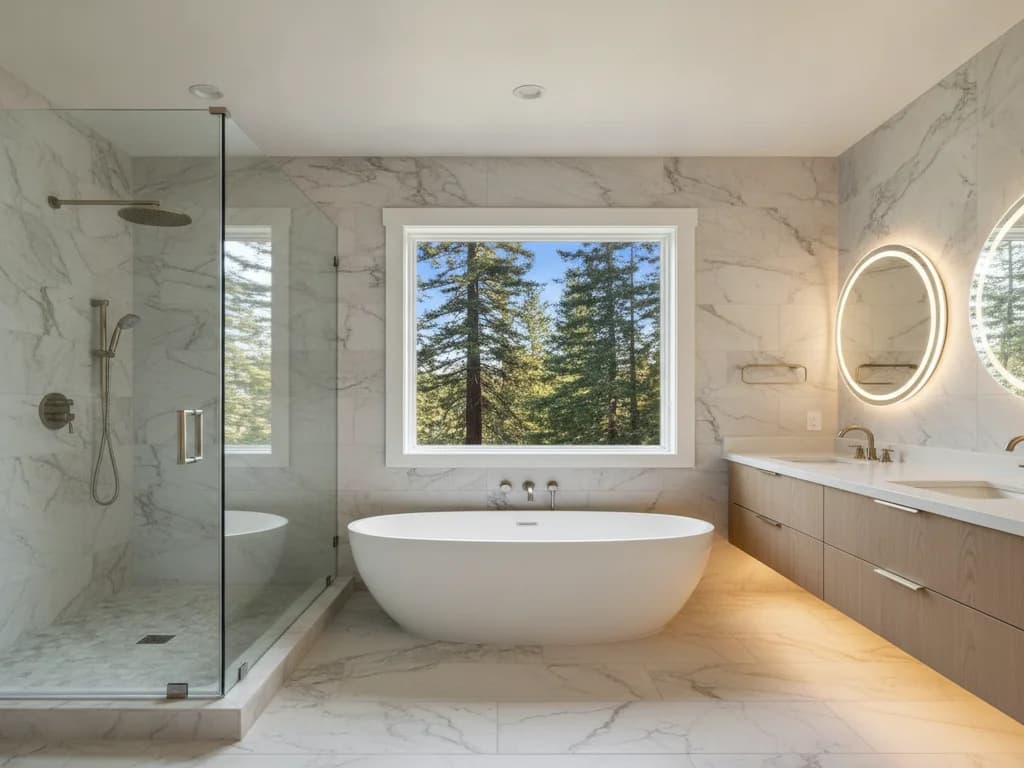
A bathroom in a Southwest Washington marine climate carries a moisture load most of the country doesn't deal with — not just from showers and sinks, but from the ambient humidity that sits in the air most of the year. That reality changes which materials genuinely belong in a Clark or Cowlitz county bathroom and which ones, while fine in a drier climate, are simply the wrong choice here.
This guide covers the materials — from the waterproofing layer you never see to the finish coat you touch every day — that hold up in our climate, and the ones we steer clients toward or away from because of it.
This guide is part of our full Bathroom Remodeling Guide and pairs with our broader pillar on moisture, rot, and the building envelope in the Pacific Northwest — the same building-science principles that protect your siding and framing apply, at a smaller scale, inside every bathroom wall.
This is the most important material decision behind any tiled shower, and it's the one that's invisible once the project is finished — which is exactly why it's worth understanding before work starts.
- Cement board (backer board) alone is water-resistant, not waterproof — it can still absorb and transmit moisture over time if it's the only layer behind the tile.
- A dedicated waterproofing membrane, applied over the backer board or as an integrated sheet system, is what actually stops water from reaching the framing.
- Membrane systems are tested to the tile industry's ANSI A118.10 standard for load-bearing, bonded waterproof membranes — a benchmark worth asking any contractor about.
- The shower pan needs the same treatment as the walls — a sloped, sealed, waterproofed base under the tile floor, not just a store-bought pan liner alone.
Porcelain tile
Best overall choiceDense, low-absorption body that resists water intrusion even without a glaze on some products — the standard recommendation for shower walls and floors in our climate.
Glazed ceramic tile
Strong choiceThe glaze layer is impervious to water; the unglazed edges and cut edges are where sealing and correct installation still matter.
Natural stone (marble, travertine, slate)
Use with a sealing planBeautiful, but porous — needs a quality penetrating sealer applied at installation and reapplied on a schedule to keep resisting moisture and staining.
Epoxy or urethane grout
Best grout choiceNon-porous and far more mold- and stain-resistant than standard cement grout, which is worth the added cost in a marine-climate wet room.
- Plywood cabinet boxes hold up better than particleboard in a bathroom's humidity — particleboard swells and delaminates when it takes on moisture over time.
- Vanities with a marine-grade or moisture-resistant finish on all sides (including the back and bottom, not just the visible faces) resist swelling at the toe-kick, where splashes collect.
- A raised vanity base or leveling feet keep the cabinet bottom off a floor that may see occasional standing water.
- Solid-surface or quartz vanity tops resist water far better than a wood or laminate counter around the sink cutout.
Outside the direct wet zone, moisture- and mold-resistant drywall paired with a bathroom-rated paint formulated with mold inhibitors gives the rest of the room a fighting chance against the condensation a shower generates every day. Neither material is a substitute for ventilation — they buy resilience against the humidity that ventilation doesn't catch immediately, not a replacement for clearing that humidity in the first place.
Standard drywall (non-moisture-resistant)
Regular drywall's paper facing is a food source for mold once it stays damp — moisture- and mold-resistant board (sometimes called green board or purple board) is the baseline for any bathroom wall, and cement board or a waterproofed backer is required in the wet zone itself.
Standard interior paint
A dedicated bathroom or kitchen-and-bath paint formulated with mold inhibitors and a washable, moisture-resistant finish holds up to condensation far better than a standard flat or eggshell interior paint.
Particleboard cabinet boxes
Swells and delaminates when it absorbs humidity over time — a slow failure that often isn't visible until the cabinet door won't close right or the toe-kick is soft.
Cement grout with no sealer, left unsealed
Standard cement grout is porous and will absorb water and harbor mildew without a penetrating sealer applied at installation and renewed periodically.
Even the best waterproofing membrane, moisture-resistant board, and epoxy grout are fighting a losing battle if the room can't clear the humidity a shower generates. Materials manage the moisture that reaches a surface; ventilation removes the moisture from the air before it settles on that surface in the first place. The two work together — durable materials are the backstop, not the primary defense.