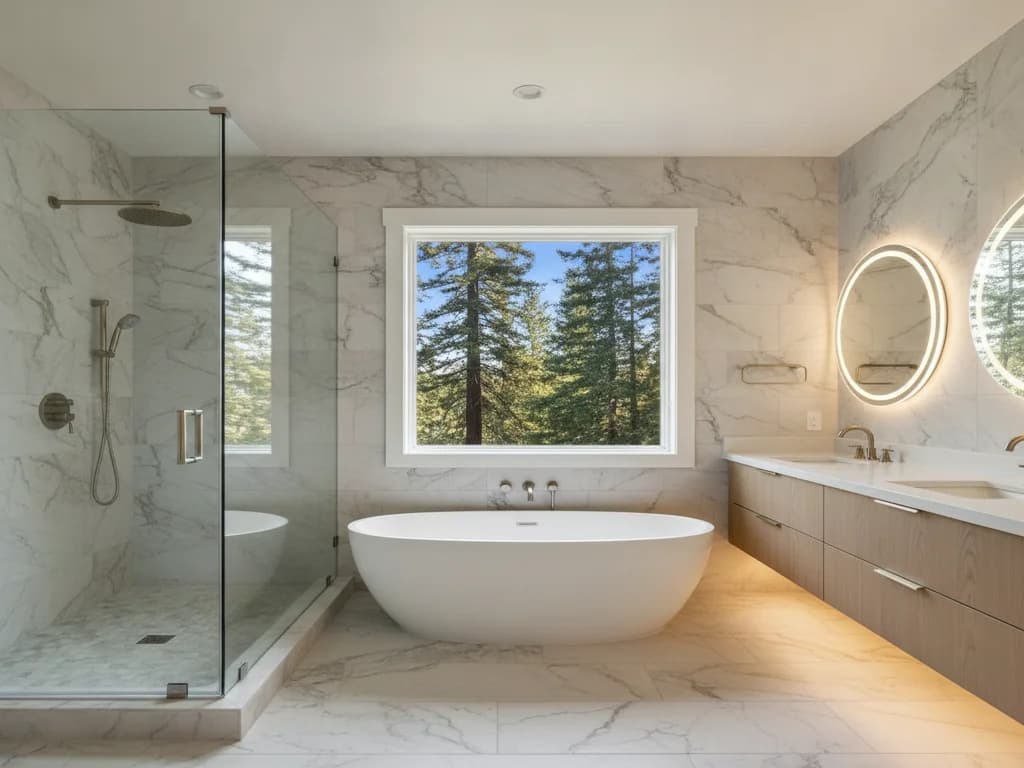
Bathroom flooring gets asked to do more than any other floor in the house: stay watertight under daily showers and splashes, resist the ambient humidity of a Pacific Northwest marine climate, and still look good underfoot every morning. In Vancouver, Camas, Battle Ground, and the rest of Clark and Cowlitz counties, that combination of near-constant humidity and a wet-most-of-the-year climate means the floor material itself is only half the answer — what's underneath it, and how it's sealed at the edges, matters just as much.
This guide walks through the flooring materials that actually perform in a Southwest Washington bathroom, the ones we steer clients away from, and the subfloor and waterproofing details that determine whether a beautiful floor stays beautiful for the long haul.
This guide is part of our full Bathroom Remodeling Guide, which covers waterproofing, ventilation, and layout for a Southwest Washington bathroom from start to finish.
Porcelain tile remains the default recommendation for most Southwest Washington bathroom floors, and for good reason — a dense, low-absorption body that, once set over a proper waterproofing layer and sealed at the grout, stands up to years of showers and mopping without complaint.
Advantages
- Effectively impervious to water when properly sealed at grout lines.
- Wide range of looks — including wood-look and stone-look large-format tile.
- Handles radiant heat well, so it pairs naturally with a heated-floor system.
- Long service life with minimal wear from cleaning and daily use.
Trade-offs
- Cold underfoot without radiant heat — a real consideration in our winters.
- Grout lines need periodic sealing to keep their water resistance.
- Hard surface; a dropped bottle or fixture is more likely to chip or crack.
- Professional installation matters — a poorly set floor can crack over time.
Fully waterproof, rigid-core LVP has become one of the most requested bathroom floors in our service area, largely because it's warmer underfoot than tile and considerably less expensive to install. The key word is "fully waterproof" — not every vinyl product on the shelf earns that description, so we confirm the exact product's water rating before it goes in a wet room.
Advantages
- Fully waterproof core (rigid-core or WPC) that shrugs off daily moisture.
- Warmer and softer underfoot than tile, without a radiant system.
- Lower material and installation cost than most porcelain tile.
- DIY-friendly click-lock systems, though we still recommend professional setting in a wet room.
Trade-offs
- Lower-end sheet vinyl and older laminate-style vinyl are not truly waterproof — read the spec sheet.
- Can't run radiant heat as effectively as tile; check the product's heat rating.
- Visible seams at transitions if not installed carefully.
- Doesn't carry the same resale cachet as natural stone or porcelain in a primary suite.
A handful of otherwise-attractive materials struggle specifically because of what a bathroom in a wet climate asks of a floor. None of these are bad products in the right room — they're just the wrong fit for a Southwest Washington wet room.
Solid hardwood
Wood swells, cups, and can rot when it takes on the humidity a bathroom generates day after day — even with a good finish, it's a losing bet in a marine climate.
Laminate flooring
Most laminate cores are wood-fiber based and will swell at the seams the first time water sits on the floor, whether from a shower splash or a slow leak nobody noticed yet.
Uncoated natural stone with soft grout
Porous stones like some marbles and travertine need diligent, ongoing sealing to resist staining and moisture intrusion — beautiful, but higher-maintenance than most homeowners want in a daily-use bathroom.
Small, sheet-mounted mosaic on a poor slope
Not the tile's fault — but tiny tile multiplies grout lines, and if the substrate underneath isn't sloped correctly to the drain, water pools instead of draining.
The floor you see is not what actually keeps water out of your subfloor and the framing below it — that's the job of a waterproofing membrane or uncoupling mat installed underneath the tile or flooring, along with correctly sealed transitions at the tub, shower curb, and toilet flange. In a climate that stays humid most of the year, skipping this layer is the single most common reason a bathroom floor fails years before it should, whether that shows up as soft subfloor underfoot, lifting vinyl at the seams, or grout that never seems to fully dry.
When we open an older Southwest Washington bathroom, this is frequently where we find prior water damage — not from a dramatic leak, but from years of small amounts of moisture working past flooring that was never properly sealed underneath. We address it before anything new goes down, because a beautiful floor over a compromised subfloor is a short-term fix.
A radiant heated floor is one of the most-appreciated upgrades we install, and it makes the most sense under tile, where the floor would otherwise feel cold most of the year in our climate. It's an electric mat or cable system laid under the tile and controlled by a programmable thermostat, so it warms the room on a schedule rather than running constantly. LVP can pair with some radiant systems, but always check the product's rated heat tolerance first — not every vinyl core is designed for it.
We scope heated flooring as its own line item during your walk-through estimate, since it adds electrical work on top of the flooring installation itself, and we'll tell you honestly whether it fits your budget and layout.