A bathroom vanity has to do two jobs at once — hold your daily routine's worth of storage, and survive daily exposure to splash, steam, and the sustained humidity that comes with Southwest Washington's marine climate. Style gets most of the attention in a showroom, but material and construction decide whether the vanity still looks good in five years or starts showing swelling and separation at the seams.
We walk clients through vanity style, size, and material together, because the right choice depends as much on your bathroom's layout and household routine as it does on aesthetics.
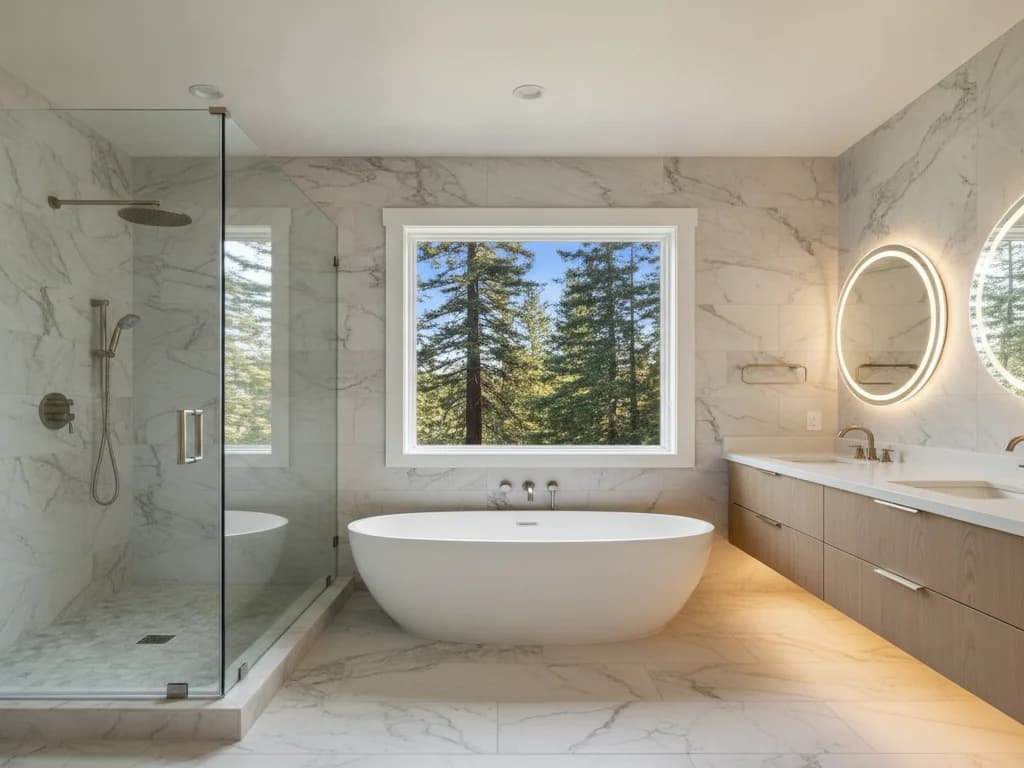
Advantages
- Visually opens up a small bathroom by exposing floor space underneath.
- Easier to clean beneath — no base cabinet trapping moisture and dust against the floor.
- A modern look that pairs naturally with a curbless shower and minimal-frame glass.
- Height is customizable to the household, which helps in an accessible or aging-in-place design.
Trade-offs
- Requires solid blocking in the wall during rough-in to support the cabinet and countertop weight — not a simple swap into an existing wall.
- Typically offers less storage volume than a comparable freestanding cabinet.
Advantages
- Maximum storage — full-depth drawers and cabinet space down to the floor.
- Widest range of styles, from traditional furniture-style pieces to simple modern boxes.
- Simpler installation in most existing bathrooms since it doesn't require added wall blocking.
Trade-offs
- Takes up more visual floor space, which can make a small bathroom feel more closed in.
- The toe-kick area at the floor is more exposed to splash and mopping water than a raised, floating design.
A double vanity is a popular request for a primary suite bathroom shared by two people getting ready at the same time, but it needs room to work well — cramped sinks with no elbow room defeat the purpose. As a general guide, we look for enough width to give each sink comfortable spacing before recommending a double configuration over a single, wider vanity with more counter space.
For a secondary or hall bathroom, a single vanity almost always makes more sense, freeing up width for storage, a linen tower, or simply a more comfortable walking path.
A vanity sits closer to daily splash and steam than almost any other cabinetry in the house, and Southwest Washington's sustained indoor humidity makes material choice matter more here than in a drier climate. Plywood cabinet construction with a sealed, moisture-resistant finish resists swelling far better than particleboard, which can delaminate at the seams over time with repeated humidity exposure.
For the countertop, quartz and solid surface are essentially maintenance-free against water; sealed natural stone works well but needs periodic resealing, similar to natural stone shower tile.