Cabinets typically account for the largest single share of a kitchen remodel's budget, and they're also the element you'll touch the most — every drawer pull, every hinge, every door swing, for decades. That combination of cost and daily use makes the stock-versus-semi-custom-versus-custom decision one of the most consequential calls in the whole project.
There's no universally correct tier — a builder-grade Cascade Park kitchen with a standard footprint might be perfectly served by a quality semi-custom line, while a Vancouver craftsman bungalow with an odd ceiling height or a tight galley footprint may need custom work to actually fit the space. The right call comes down to your layout, your finish expectations, and how long you plan to stay in the house.
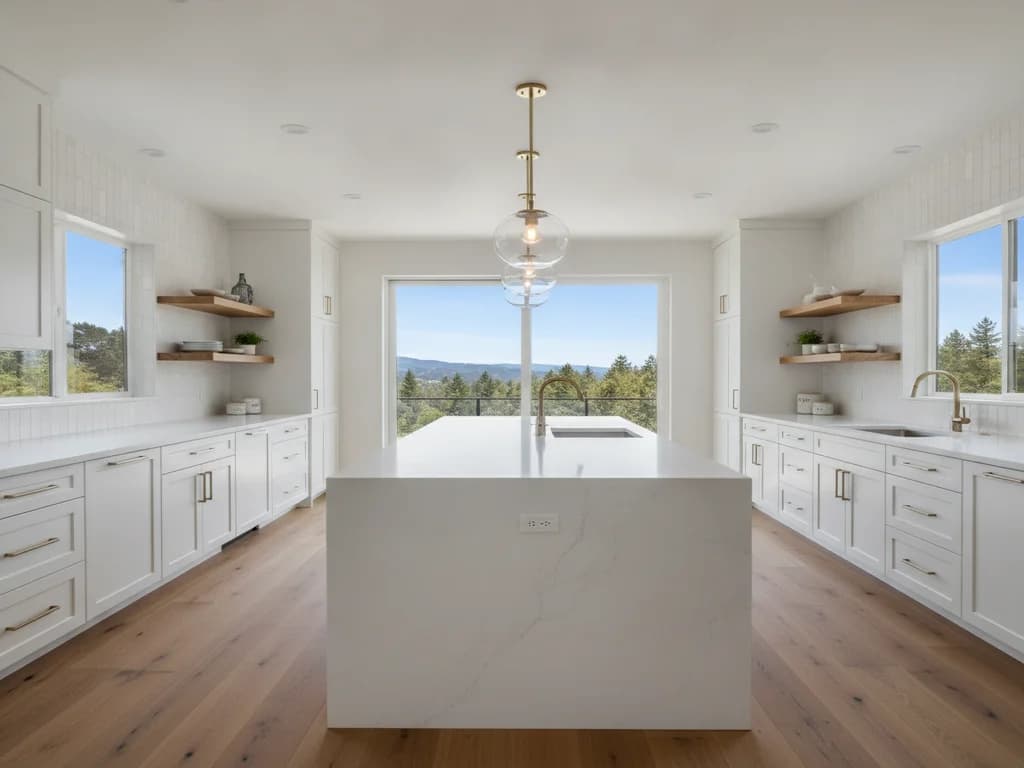
Stock cabinets
Advantages
- Lowest cost per linear foot and shortest lead times, since they ship from pre-built inventory.
- Widely available in a range of standard sizes and popular finishes.
- A reasonable fit for standard-footprint kitchens common in newer Camas, Ridgefield, and Battle Ground subdivisions.
Trade-offs
- Fixed sizing in set increments — awkward corners, odd wall widths, and non-standard ceiling heights often need filler panels to make up the gap.
- Fewer options for specialty storage (appliance garages, pull-out spice racks, custom-depth pantry cabinets).
- Construction quality varies significantly between brands, so it pays to inspect box construction and drawer hardware before committing.
Semi-custom cabinets
Advantages
- A much wider range of sizes, finishes, and door styles than stock, often in half-inch or smaller size increments.
- Extensive interior storage options — pull-out trash/recycling, deep drawers instead of shelves, corner solutions.
- The most common choice for full kitchen remodels in our region — it balances real customization against cost and lead time.
Trade-offs
- Costs more than stock and takes longer to arrive, typically several weeks to a couple of months depending on the manufacturer.
- Still built from a manufacturer's core system, so truly unusual dimensions (a very tall or very shallow run) may hit limits.
Custom cabinets
Advantages
- Built to your exact dimensions — the only real option for irregular layouts, non-standard ceiling heights, or a very specific design vision.
- Unlimited configuration: any wood species, any finish, any interior storage detail.
- Often built by a local or regional cabinet shop, which can also mean easier repairs and exact-match replacement pieces down the road.
Trade-offs
- The highest cost per linear foot and the longest lead time — often the pacing item that sets your whole project schedule.
- Requires more precise on-site measuring and design coordination before the order is placed, since changes after fabrication starts are difficult.
Southwest Washington's marine climate — persistent rain, higher ambient humidity, and cooler indoor-outdoor temperature swings during the wet months — matters more for cabinetry than most homeowners expect. Solid wood cabinet doors and face frames can expand and contract seasonally with humidity changes, which is normal, but it's worth choosing a cabinet line with a finish system designed to handle that movement without cracking at the joints.
Cabinets on an exterior wall, especially in an older, less-insulated home, are also more prone to condensation on interior surfaces during cold snaps if the wall isn't well insulated behind them. Where we're installing new cabinetry against an exterior wall in an older Hazel Dell or Orchards ranch, we check the wall's insulation and vapor management as part of the scope — not just the cabinet install — because a beautiful new cabinet run against a damp wall is a problem waiting to happen.
Below sinks and near dishwashers, moisture-resistant cabinet-box construction (plywood over particleboard, sealed edges) earns its cost. It's a small percentage of the total cabinet order but the highest-risk location in the kitchen for water damage over time.
- Shaker (a recessed center panel with a simple flat frame) remains the most requested style across our service area, largely because it reads as both traditional and contemporary depending on the finish and hardware paired with it.
- Flat-panel / slab doors suit more contemporary kitchens, particularly in newer construction and full-gut remodels where the rest of the home has moved toward a cleaner aesthetic.
- Raised-panel and inset door styles, more traditional and labor-intensive to build, show up most often in period-appropriate restorations of Vancouver's older craftsman and Victorian-era homes.
- Painted finishes (in-frame or overlay) are more common than stained wood grain in current kitchens region-wide, though stained and mixed-material kitchens — a painted perimeter with a stained wood island — remain popular for adding warmth.
- Soft-close hinges and drawer glides are close to standard now across all three tiers and are worth insisting on if a quoted line doesn't include them.
- Deep drawers instead of lower cabinet shelves make pots, pans, and small appliances far easier to access — a detail that costs little extra when specified up front but is expensive to retrofit later.
- Corner solutions (lazy Susans, blind-corner pull-outs) recover storage that's otherwise dead space, especially valuable in L-shape and U-shape layouts.
- A dedicated pantry cabinet or walk-in pantry conversion is one of the most requested additions we see in kitchen remodels across Clark County, particularly in older homes that were never built with one.
Choose stock if
- Your kitchen has a standard, rectangular footprint with no unusual angles.
- Budget and speed matter more than deep customization.
- You're refreshing rather than fully reconfiguring the room.
Choose semi-custom if
- You want real style and storage options without a custom-shop price tag.
- Your layout is mostly standard but has a corner, island, or pantry detail worth solving well.
- This describes the majority of full kitchen remodels we build across Southwest Washington.
Choose custom if
- Your home has non-standard dimensions — an older bungalow, a sloped ceiling, an unusual wall length.
- You have a specific design vision that off-the-shelf systems can't achieve.
- You plan to stay in the home long-term and want cabinetry built to last with easy future repair.