Large-format tile — generally 12x24 inches and up, with some porcelain panels reaching several feet on a side — has become one of the most requested looks in bathroom remodels, and for good reason. Fewer seams read as cleaner and more modern, and in a marine climate where grout lines are one of the places moisture and mildew can take hold, fewer seams is also a genuine maintenance advantage, not just an aesthetic one.
But large-format tile is less forgiving than smaller tile about what's underneath it. A flat, well-prepared substrate isn't optional — it's the difference between a wall or floor that reads seamless and one with visible lippage at every edge. We treat large-format tile as a substrate-first decision, not a tile-first one.
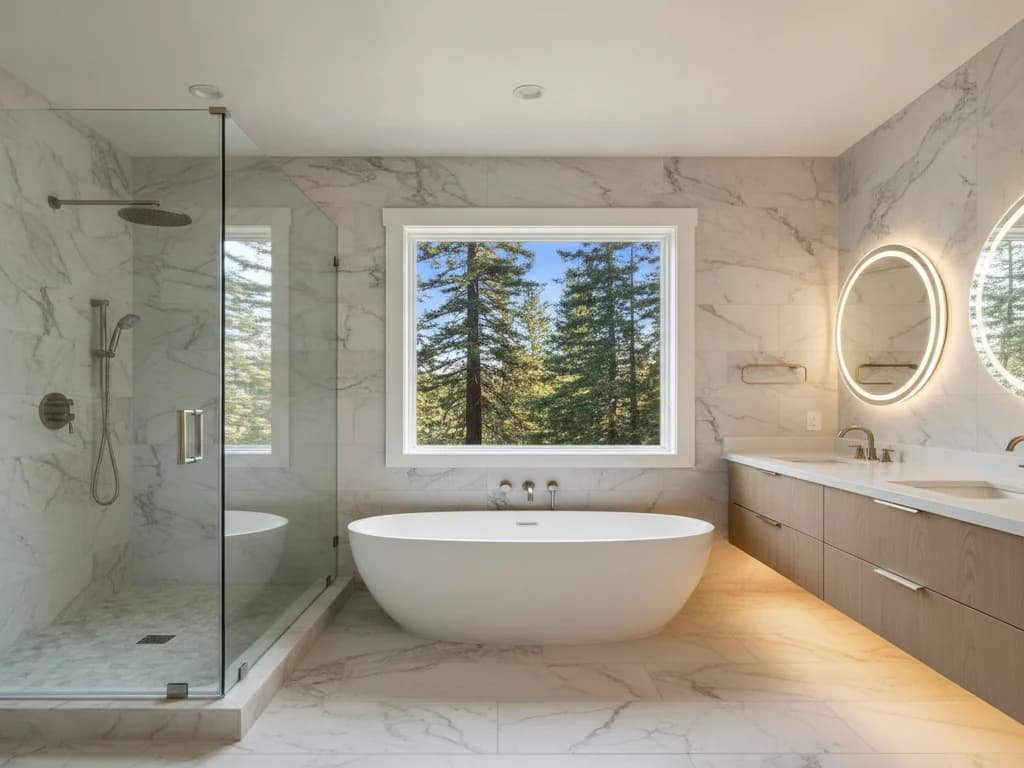
Because a large-format tile spans more distance edge to edge, it has far less tolerance for an out-of-plane substrate than a small mosaic tile does — even a slight dip or hump in the wall or floor telegraphs through as a visible lippage line between tiles, since there's no adjacent grout joint every few inches to absorb the variation. Most manufacturers and installation standards call for substrate flatness within a fraction of an inch over a several-foot span for large-format tile, tighter than what's acceptable for standard-size tile.
Getting there usually means a flattening or leveling step before tile begins — a self-leveling underlayment on floors, or shimming and skim-coating on walls — that's a real line item in the project, not a given. Large-format tile installers also typically use a back-buttering technique (applying thinset to both the substrate and the back of the tile) to achieve full mortar coverage across the larger surface, since inadequate coverage under a big tile is more likely to crack under load or thermal movement than under a small one.
This is also why large-format tile pairs well with our large-format tile guide's sibling recommendation for shower floors: the same slope tolerance that makes large tile hard on a flat wall makes it even harder on a sloped shower pan floor, which is why smaller mosaic tile remains the standard for that specific surface even in an otherwise large-format shower.
Fewer grout lines mean less grout to clean, less grout to reseal on a schedule, and fewer places for soap scum and mildew to accumulate — a real advantage in a climate where a bathroom rarely gets a long, fully dry stretch between uses. A shower wall tiled in 12x24 panels might have a fraction of the total grout linear footage of the same wall tiled in 4x4 tile, which adds up over years of maintenance.
The tradeoff is that with fewer, larger tiles, any single crack, chip, or installation flaw is more visible and more expensive to replace than swapping out one small mosaic piece. It's a maintenance-frequency-versus-repair-cost tradeoff, and most of our clients find the reduced day-to-day maintenance well worth it.
Advantages
- Fewer grout lines — less cleaning, less resealing, and fewer places for mildew to take hold.
- Reads as a clean, current, high-end look on walls and floors alike.
- Available in realistic wood-look, stone-look, and concrete-look porcelain finishes.
- Fewer seams can make a small bathroom feel visually larger.
Trade-offs
- Requires a flatter substrate than standard tile, which can add a leveling or skim-coat step to the project.
- Needs a skilled installer experienced with back-buttering and large-tile handling to avoid lippage and cracking.
- Not the right choice for a sloped shower pan floor, where smaller tile follows the curve more cleanly.
- Individual tiles cost more to replace if damaged, since there's no small, cheap piece to swap.
Large-format tile shines on shower walls, bathroom floors outside the shower pan, and tub surrounds — any large, relatively flat plane where minimizing seams pays off both visually and in maintenance. It's less suited to a sloped shower floor, tight corners, or highly irregular surfaces, where a mosaic or standard-size tile follows the geometry more cleanly.
Many of our clients pair large-format tile on the walls with a small-format mosaic specifically on the shower floor — getting the clean, low-maintenance look where it matters most while keeping the floor's slope and slip resistance where it also matters most.