Porcelain, ceramic, and natural stone are the three material families behind nearly every tile choice in a Southwest Washington bathroom, and in our sustained-humidity marine climate, the differences between them matter more than in a drier region. Water absorption, sealing requirements, and how each material handles years of daily shower use all vary meaningfully — this guide breaks down each material on its own, then compares them directly.
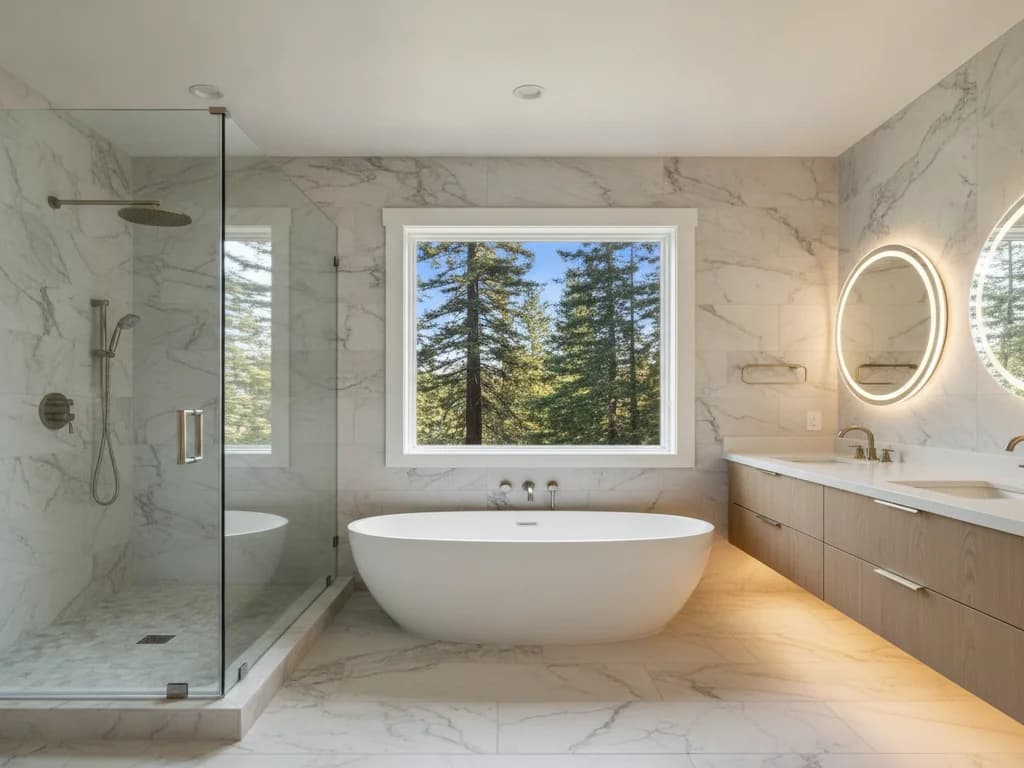
Advantages
- Very low water absorption (typically under 0.5%), making it inherently more moisture-resistant than ceramic or most natural stone.
- Dense and hard-wearing — holds up well to daily shower and floor traffic over decades.
- Available in realistic wood-look, stone-look, and concrete-look finishes at a range of price points.
- No sealing required for the tile itself (grout still needs its own maintenance).
Trade-offs
- Denser material is harder to cut, which can add labor cost on intricate layouts.
- Premium large-format porcelain panels command a higher price than standard sizes.
- Can feel cold underfoot without supplemental heat — see our heated floors guide.
Advantages
- Generally the most budget-friendly of the three material families.
- Wide availability in a huge range of colors, patterns, and sizes, including classic subway formats.
- Easier to cut than porcelain, which can simplify intricate patterns and tight layouts.
Trade-offs
- Higher water absorption than porcelain, making it better suited to walls and lower-moisture areas than shower floors.
- Generally softer and more prone to chipping than porcelain under heavy impact.
- Glazed ceramic can be more slip-prone in a wet, matte-free finish — worth checking the specific product's slip rating for floor use.
Advantages
- A genuinely unique, natural material — no two slabs or tiles are identical.
- Marble, travertine, slate, and other stones each bring a distinct texture and color range unmatched by manufactured tile.
- Often used as an accent — a niche, feature wall, or vanity top — paired with porcelain field tile for the rest of the shower.
Trade-offs
- Porous — requires sealing at installation and on an ongoing schedule to resist staining and moisture absorption.
- Softer stones like marble and travertine can etch from acidic cleaners and require gentler maintenance products.
- Typically the most expensive of the three material families, both in material and in the more particular setting materials it needs.
- Heavier than porcelain or ceramic, which can affect substrate and setting-bed requirements.
Porcelain lowest (most moisture-resistant), ceramic moderate, natural stone varies widely but generally most porous.
Porcelain lowest — no sealing required. Ceramic low. Natural stone highest — sealing at install and on an ongoing schedule.
Ceramic generally lowest, porcelain mid-to-premium depending on format, natural stone typically highest.
Porcelain for walls and floors broadly. Ceramic well-suited to walls. Natural stone as an accent paired with a lower-maintenance field tile.