Shower tile gets chosen for how it looks in a showroom, but in Southwest Washington's marine climate it also has to perform every single day against a wet, humid environment that doesn't fully let up for months at a time. The tile itself isn't what keeps water out of your walls — that's the membrane behind it — but the tile you choose does affect how much maintenance the surface needs, how slip-resistant the floor is, and how forgiving the finished shower is over the next decade.
We help clients pick tile after the waterproofing plan is set, not before, because some materials (natural stone especially) change what substrate and membrane the installation needs.
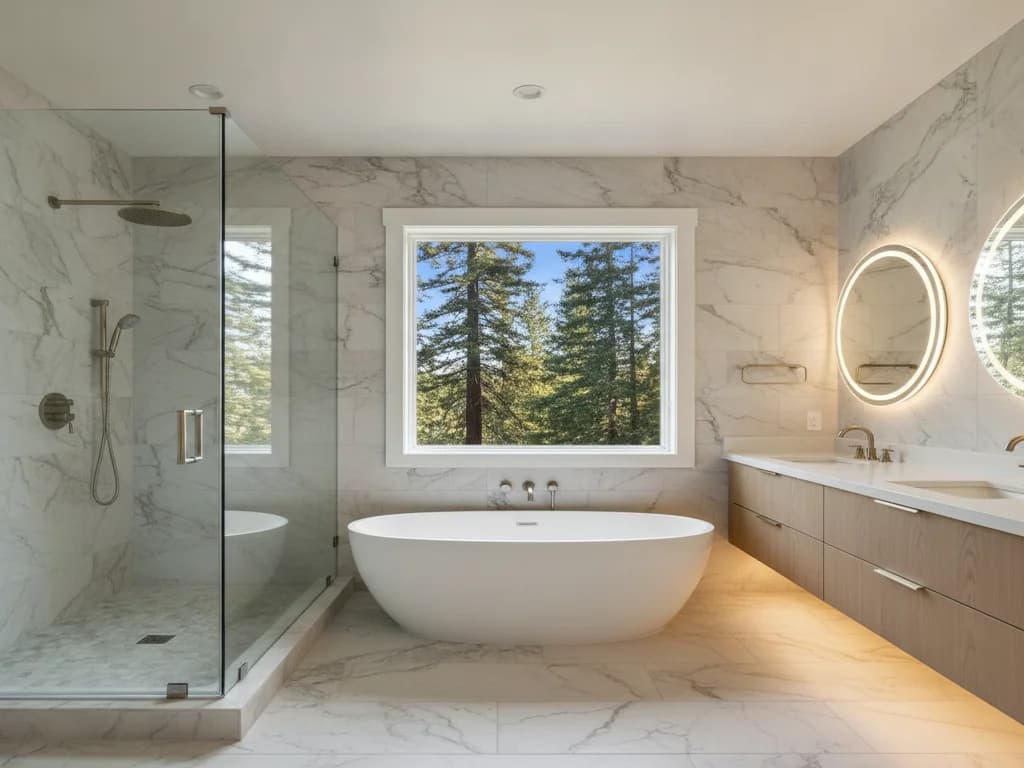
Advantages
- Extremely low water absorption — porcelain is inherently more moisture-resistant than most natural stone.
- Available in large-format panels that reduce grout lines, which means fewer places for mildew to take hold.
- Wide range of finishes, including realistic wood-look and stone-look porcelain that mimics higher-maintenance materials.
- Generally the most budget-friendly premium option per square foot.
Trade-offs
- Large-format panels require a skilled installer and a flat, well-prepared substrate to avoid lippage.
- Can feel cold underfoot without supplemental heat.
Advantages
- A genuinely unique, natural look — no two slabs or tiles are identical.
- Marble, travertine, and slate each bring a distinct texture and color range.
- Often chosen for accent niches or feature walls paired with porcelain field tile.
Trade-offs
- Porous — requires sealing at installation and re-sealing on an ongoing schedule to resist staining and moisture absorption.
- Softer stones (marble, travertine) can etch from acidic cleaners.
- Typically the most expensive tile category, and the membrane and setting materials behind it are more particular.
The floor of a shower carries different requirements than the walls. It needs to slope to the drain, which usually means smaller-format tile so the grout lines can follow the pan's curve without excessive cutting or lippage. It also needs traction — a glossy, polished finish that looks striking on a wall becomes a hazard underfoot when wet.
We generally recommend a textured or matte-finish porcelain mosaic for shower floors, sized small enough to follow the slope cleanly, with a coefficient-of-friction rating suited to a wet barefoot environment.
Tile is only as low-maintenance as its grout. Cementitious grout is porous and needs periodic sealing to resist staining and moisture intrusion — a task that matters more in a climate where the bathroom rarely gets a long, fully dry stretch. Epoxy grout costs more upfront but resists stains and moisture without ongoing sealing, which many of our clients find worth the premium for a shower they use daily.
Whichever grout you choose, the exhaust fan doing its job matters just as much as the tile itself — grout that dries quickly after each shower resists mildew far better than grout sitting in trapped humidity.