A shower is the single wettest, most heavily engineered square footage in a Southwest Washington home, and it earns its own deep-dive apart from the rest of the bathroom. Every decision inside it — the membrane behind the wall, the slope of the floor, the tile on top, the fan pulling humid air out — has to work together to keep water exactly where it belongs in a climate that gives a shower very little dry-air recovery time between uses.
This pillar is the hub for that decision-making. It pulls together how a shower actually gets waterproofed, the pan and base options available, curbless and wet-room design, how tile materials perform in sustained marine humidity, large-format versus mosaic layout tradeoffs, grout and mold control, heated floors for cold mornings, and glass and fixture choices. Each section links out to a focused guide with the full detail, and the whole cluster connects back to our broader bathroom remodeling guide and our building envelope guide for the moisture principles that apply to the rest of the house.
For the broader moisture principles behind every wet room in a marine climate, see our building envelope guide, and for the full bathroom remodel picture, our Bathroom Remodeling Guide.
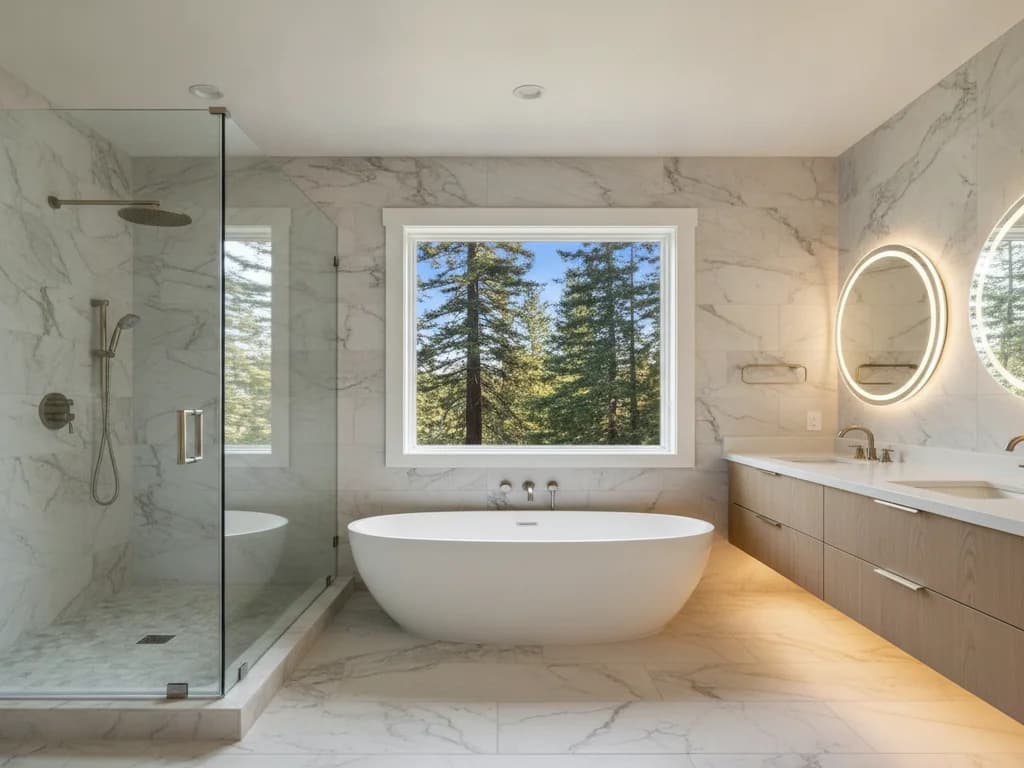
The membrane does the work, not the tile
Tile is a durable, attractive wear surface. The actual barrier against water intrusion is a continuous waterproofing membrane — a sheet product or a liquid-applied coating — installed over the substrate with every seam, corner, niche, and penetration sealed as one unbroken layer. Building scientists describe this as a drainage-plane principle: every cladding eventually lets some water through, so the layer behind it is what has to stop it.
Where waterproofing typically fails
Most shower leaks we're called to diagnose trace back to a handful of predictable spots: the inside corner of a niche, the transition where a bench meets the wall, the drain flange, or the curb. These transitions require the membrane to wrap continuously around a change in plane rather than stop and restart — a step that takes real installer discipline to get right the first time, because it's invisible once tile goes down.
Cure time is not optional
Liquid and sheet membranes need to fully cure before thinset and tile go over them, and rushing that step to hit a schedule is one of the more common causes of early failure. We build proper cure time into every shower schedule rather than treat it as a place to save a day.
The rainwater-control principle behind this — every cladding leaks eventually, so the drainage layer behind it is what actually stops water — comes from Building Science Corporation's moisture-control research. For the full detail on membrane types and where leaks actually start, see our shower waterproofing guide.
Every shower sits on one of three general base systems: a traditional mud-set (deck-mud) pan built and sloped on site, a pre-formed shower base or pan set beneath the tile, or a fully custom tiled pan integrated with a linear or center drain. Each has a different balance of cost, customization, and installation risk, and the choice interacts directly with whether the shower will be curbless.
We cover the full comparison — including center versus linear drains and when each makes sense — in our dedicated pan and base guide.
A curbless (zero-threshold) shower removes the curb entirely, using a sloped floor or a linear drain at the threshold so the shower floor and the bathroom floor sit at the same plane. It's one of the most requested features we build, both for aging-in-place planning and simply because open, doorless showers read as clean and modern regardless of who's using them.
Curbless design asks more of the waterproofing and framing than a standard curbed shower — the whole bathroom subfloor may need to be recessed or built up around the drain to create the slope without a curb to contain it. A true wet room takes that a step further, waterproofing and tiling the entire bathroom floor as one continuous wet zone rather than isolating the shower behind glass.
Porcelain and ceramic
Porcelain has extremely low water absorption and holds up to sustained humidity with minimal maintenance, which makes it the workhorse choice in our climate. Ceramic is a related, generally more affordable option best suited to walls and lower-moisture areas.
Natural stone
Marble, travertine, and slate bring a genuinely unique look but are porous and need sealing at installation and on an ongoing schedule to resist staining and moisture absorption — a maintenance commitment that matters more here than in a drier climate.
For the full material-by-material comparison, see our porcelain vs. ceramic vs. stone guide and our shower tile options guide.
Large-format tile (generally 12x24 inches and up) minimizes grout lines, which is both a cleaner modern look and fewer places for mildew to take hold — but it demands a flatter substrate and a more skilled installer to avoid lippage. Mosaic and small-format tile follow curved or sloped surfaces (like a shower pan floor) far more cleanly, and the added grout lines improve slip resistance underfoot.
Subway tile sits in between — a mid-size format with a long track record, flexible pattern options, and grout lines that are easy to maintain without the substrate demands of true large-format panels.
Grout is a maintenance item, not a waterproofing layer. Cementitious grout is porous and needs periodic sealing to resist staining and moisture; epoxy grout costs more upfront but resists both without ongoing sealing. Either way, mold control in a shower comes down to two things working together: grout that's sealed and clean, and a bathroom fan that actually clears the humid air after every use.
The EPA's guidance on mold and moisture control is direct on this point — mold needs sustained moisture to establish itself, and keeping indoor humidity controlled and drying wet surfaces quickly is the most effective prevention. In a marine climate where ambient humidity is already elevated for much of the year, that fan is doing real work, not just satisfying code.
Electric radiant floor heating under shower and bathroom tile is one of the more popular upgrades we install, and it earns its keep specifically in our climate — cold, damp mornings for a large part of the year make a heated tile floor feel like a genuine comfort upgrade rather than a luxury add-on. It installs as a thin mat or cable system beneath the tile, tied to its own thermostat, and adds relatively little to the floor buildup.
Shower glass
Frameless glass is the cleanest, most current look and has no metal frame to trap water and soap scum, but it costs more and typically needs thicker glass to stand on its own structurally. Framed and semi-frameless enclosures cost less and can be a practical choice for a secondary bath.
Fixtures
Rainfall heads, handhelds, body sprays, and thermostatic valves each add plumbing complexity and cost, but a well-planned fixture package is one of the most noticeable everyday upgrades in a shower remodel. Thermostatic valves in particular hold water temperature steady, which matters in any home but especially where incoming water temperature can swing seasonally.
For the full glass comparison, see our shower glass options guide. The National Kitchen & Bath Association's planning guidelines, published by NKBA, inform our fixture and clearance recommendations across every shower we design.