A steam shower is a genuinely different build than a standard shower, not just a shower with an extra appliance bolted on. A steam generator fills a fully enclosed space with saturated vapor, which means every wall, the ceiling, the door, and every penetration in that enclosure has to hold vapor in rather than just shedding splashing water — a materially higher bar than standard shower waterproofing.
In Southwest Washington, that higher bar matters even more than it would in a drier region. Our marine climate already keeps ambient humidity elevated much of the year, which limits how quickly building materials here dry out on their own. A steam enclosure that isn't fully vapor-sealed doesn't just leak a little moisture into the wall or ceiling cavity behind it — it pushes sustained, concentrated vapor into a cavity that already has less drying potential than it would in a dry climate, which is a real path to hidden mold and rot if the envelope isn't built correctly.
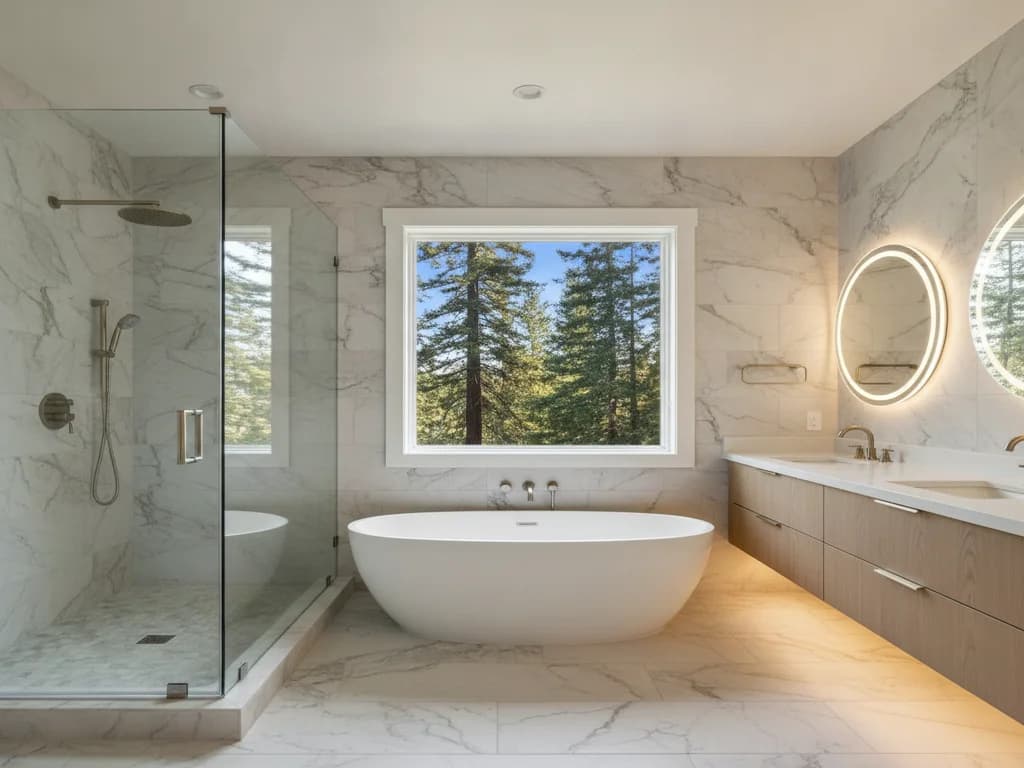
A steam enclosure needs a true vapor barrier behind the tile, not the moisture-resistant membrane used in a standard shower. A few details matter most:
- A true vapor barrier goes behind the tile in a steam enclosure — this is a step beyond the moisture-resistant membrane used in a standard shower, because saturated steam behaves differently than splashing water.
- The ceiling is sloped, not flat, so condensation forming overhead runs down the slope and back into the shower rather than dripping directly onto the person underneath — a small detail with a real comfort payoff.
- Every penetration through the enclosure — light fixture, speaker, steam head, any control — gets sealed individually, since each one is a potential point for vapor to escape into the wall or ceiling cavity.
- The enclosure is sized and sealed floor-to-ceiling, with no gap at the top the way a standard shower stall sometimes has, because steam rises and fills the entire enclosed volume.
While the enclosure is running, it's meant to hold vapor in — that's the entire point of sealing it so completely. The real ventilation job happens after: clearing the surrounding bathroom, and helping the enclosure itself dry out, once the session ends. We size the bathroom's exhaust fan generously for this, above what a standard shower would need, because a steam cycle puts far more moisture into the air at once than a normal shower does.
In our marine climate, where ambient humidity is already elevated much of the year, giving that moisture somewhere to go quickly is what keeps a steam shower from becoming a hidden mold problem. We often recommend the fan run on an extended timer well past the end of a steam session rather than shutting off with the light.
The glass enclosure is what actually holds the steam in the room, which means it's built differently than a standard shower's glass panels:
- Frameless tempered glass panels, sealed at the edges with a continuous silicone gasket rather than left open, keep vapor contained the way a standard shower's partial-height glass doesn't need to.
- A full-height enclosure — floor to ceiling, not stopping short with an open transom — is what actually holds the steam in; an open top defeats the purpose.
- Doors typically swing or pivot outward for safety and ease of use, sized and hung so the gasket seals fully against the frame when closed.
- Anti-fog or etched glass treatments are a finish option worth considering, since a steam enclosure fogs the glass more heavily and more often than a standard shower.
The generator itself is sized to the enclosure's cubic footage, not to a general shower size — an undersized generator will never bring a larger enclosure up to temperature, and an oversized one wastes energy and water in a small one. Most installations put the unit in an adjacent closet, cabinet, or mechanical space within a set distance of the steam head, connected by insulated piping.
It needs a dedicated electrical circuit, a water supply, and a drain connection, along with a control — usually a digital, often app- or remote-controlled interface mounted inside or just outside the enclosure. An access panel at the generator location matters as much as any visible finish, since the unit needs to be reachable for service without opening a finished wall.